

Why We’re Growing Our Cider Apples on Wires | Jan’s Blog
Why We’re Growing Our Cider Apples on Wires
In our last orchard blog, we talked about why Vancouver Island, and particularly the Cowichan Valley, is such a good place to grow cider apples.
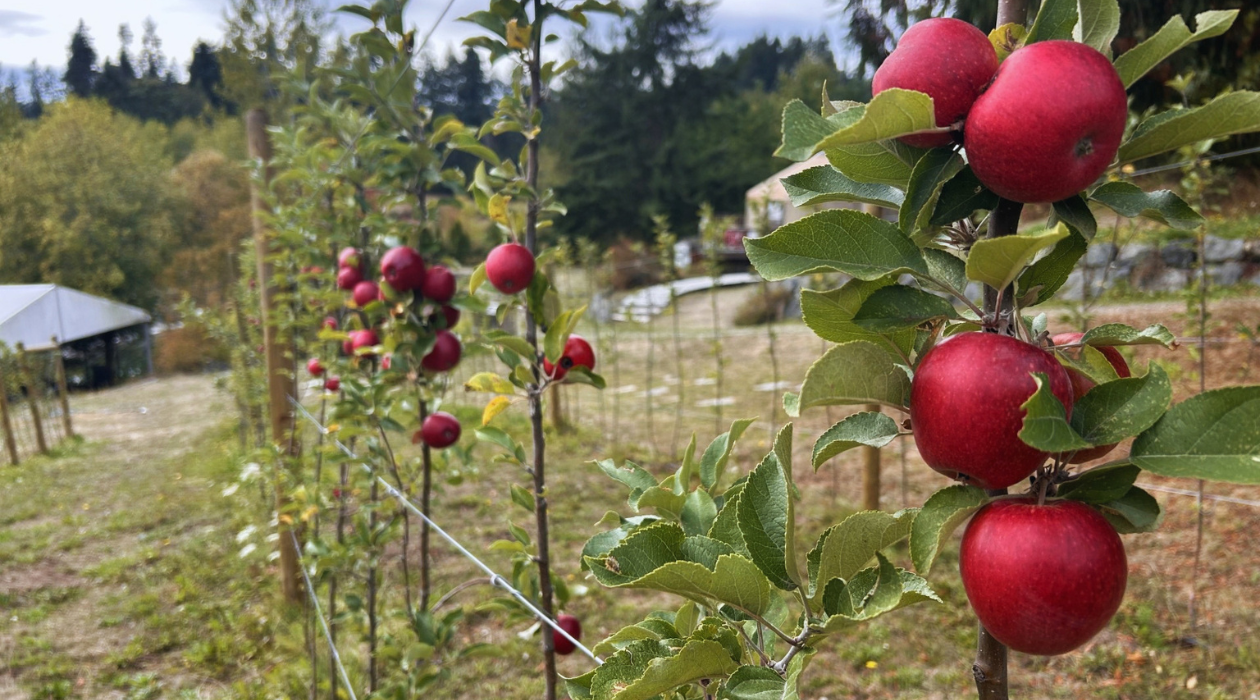
This time, we’re getting a little closer to the trees. If you’ve walked through the newer part of our orchard, you may have noticed that the trees look quite different from the older orchard. They’re smaller, planted much closer together and trained along wires. Yes, wires. It can look a little like we’re growing an apple fence. There’s actually some very good orchard science behind it.
Smaller trees. More apples.
First, a small clarification: the wires aren’t replacing the rootstock. The rootstock controls the size and vigour of the tree, while the trellis gives the smaller tree the support it needs. By using dwarfing or semi-dwarfing rootstocks and planting trees closer together, we can create a high-density orchard. Instead of having a few large trees taking up a lot of space, we have more smaller trees, each with a manageable amount of fruiting wood.
And smaller trees tend to start producing earlier. That matters. An apple tree is a long-term investment, and waiting years for a big tree to finally get around to producing a commercial crop isn’t exactly a thrilling business model.
Research into high-density apple systems shows that smaller trees can produce fruit earlier and make better use of the available land. The important measurement isn’t necessarily how many apples one tree produces. It’s how much fruit the whole orchard produces per acre. In other words, the tree doesn’t have to be big to be productive. I love that!
It’s really about sunlight
One of the big advantages of a trellised orchard is being able to manage the tree’s shape and the way sunlight moves through it. A big, sprawling apple tree can have plenty of leaves and branches doing their thing in the shade. A narrow, well-managed fruiting wall lets us make better use of available light.
Light matters.
It affects how efficiently the tree produces fruit and can influence fruit size, colour and overall quality. Training and pruning systems are increasingly being designed around better light penetration, improved yields and more efficient use of land and labour.
For cider apples, we’re not simply looking for a pretty apple. We want the right combination of flavour, acidity, sugar and tannin to give the cider character. The trellis doesn’t magically make a better apple. It gives us a better way to manage the tree that produces it.
And, selfishly, I like that they aren’t too tall. I’m 4’10”. So, let’s just say that trees I can reach without climbing a ladder have some personal appeal. But this isn’t really about my height.
Smaller, more accessible trees make pruning, thinning, monitoring and harvesting easier. The fruit is easier for people to see and reach. That’s important when labour is one of the biggest costs in an orchard.
So yes, the 4’10” farmer is pleased, but the accountant in me is pretty happy too.
There is a catch
Of course, if this were simply a matter of putting wires up and making more money, every orchard would look like this. It doesn’t.
A high-density orchard costs more to establish. There are more trees to buy, plus posts, wire, support systems and more intensive training when the trees are young. Dwarfing rootstocks also have smaller root systems and can require more careful management.
So we’re making a bigger investment at the beginning. The hope is that we get something back from that investment through earlier production, more fruit per acre and more efficient use of labour and land.
And that’s the part that interests us at Merridale. We’re not trying to grow the biggest apple trees we can. We’re trying to grow productive trees that make good cider apples, efficiently and for the long term.
The Oregon State University cider research program is looking at exactly these kinds of questions – comparing cider varieties and rootstocks and testing high-density trellised systems to see which production methods can increase yields while reducing costs. (Progress Archive)
Two orchards. Two generations of thinking.
The old orchard and the new orchard aren’t competing with each other. They’re simply two different ways of growing apples. The older trees tell the story of where we started. The newer rows are part of where we’re going.
And we’re still learning. Because we haven’t even talked about which cider apple varieties we’ve chosen to plant on those wires, and why.
That’s another story. And, frankly, a rather interesting one if you are a cider apple nerd.
A few sources behind the story
Ontario Ministry of Agriculture — Apple Rootstocks
Oregon State University — Cider Taking Root
Ontario Ministry of Agriculture — Guide to Training and Pruning Fruit Trees
Share this article
Follow us
Latest articles
October 18, 2026
October 18, 2026
October 18, 2026